Laser-Ablated Silver Nanoparticles Embedded in P3HT: A Study of Structural and Optical Enhancement
Article Sidebar
Main Article Content
Abstract
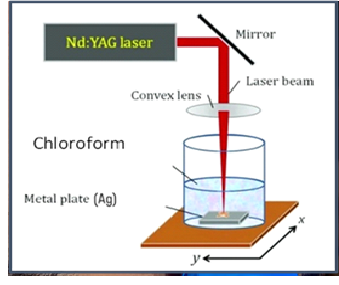
The hole transport layers are critical components of organic conductor-based devices. The metal nanoparticles (NPs) are excellent materials for this purpose. This paper describes the preparation of silver nanoparticles (Ag NPs) using a laser method, which were then mixed with the organic polymer poly(3-hexylthiophene) (P3HT) at different concentrations (0.1, 0.3, and 0.4 wt%). The structural morphology, structure, and optical properties of the new nanocomposite were examined using X-ray diffraction (XRD), field emission scanning electron microscopy (FESEM), atomic force microscopy (AFM), and UV-Vis spectroscopy. The XRD data showed that the created Ag NPs have a crystal structure, with the strongest peaks seen at angles of 38.1°, 44.3°, 64.4°, and 77.4°. The FESEM and AFM tests showed that having more Ag NPs makes the surface rougher and helps spread the nanoparticles better, where the surface roughness increased from 2.04 to 2.46 nm, the mean roughness of the film (Ra) changed from 1.55 to 1.81 nm, and the maximum height of the film (Rmax) ranged from 22.34 to 25.38 nm. The UV-Vis spectroscopy results showed that the material absorbed lighter due to the localized surface plasmon resonance (LSPR) effect, which caused the absorption peaks to move to shorter wavelengths and lowered the optical energy gap from 2.1 eV for pure P3HT to 2 eV with a 0.3 wt% concentration of AgNPs. P3HT nanocomposites with Ag nanoparticles have better structure and optical properties, which make them ideal for organic solar cells and other electronic applications
Received 11 Jun. 2025; Revised 1sept. 2025; Accepted 7 Sept. 2025; Published online 15 Dec. 2025
Article Details
Section
How to Cite